The Restaurateur
The ferry horn sounded every night at nine forty.
From the kitchen at Wingsong, I heard it through the walls, low and tired, carrying across the Sound. It marked the last arrival from Seattle. After that, Blakeford Island closed in on itself. Anyone who missed it stayed the night or paid for a private boat.
I used to time my prep to that horn. Dice onions, reduce stock, listen for it, then check the walk-in, then back to the cutting board. It was a reminder that the world was still larger than the island.
Now it just told me how many more guests would walk through the door.
“Chef,” Cory said, leaning in at the pass, “table twelve wants to know if the duck is gluten free.”
“The duck is a duck,” I said.
He held his face neutral the way good staff learn to do.
“Tell them yes,” I added. “Tell them the sauce is thickened with reduction.”
“It is thickened with flour.”
“Then tell them we can do it without sauce.”
Cory nodded and turned away. Cory was short for Cornelius. He didn’t argue anymore. Not after the commute got worse. Not after his second kid. Not after the rent went up on his apartment in Seattle and he started picking up extra shifts at a hotel bar near the pier on his days off.
I plated the duck anyway. I wiped the rim. I set a sprig of something green where it looked intentional. I slid it into the pass.
“Table twelve, course three,” I called.
The dining room was full. Candles flickered on white linen. Glassware caught the light and returned it softer. The band in the corner played slow jazz. Conversations stayed low and controlled. The room smelled like butter, citrus peel, and expensive perfume.
Walter sat at table twelve, laughing at something his wife said, his wineglass already half gone. Around him were people I knew by name and by habit. Retired surgeons. Former executives. A woman who used to be a partner at a law firm and now took watercolor classes and chaired the Beautification Committee, which mostly meant stopping anything that looked like housing.
They all lived within walking distance.
My smart glasses pinged and a message appeared. Hannah.
Gage asleep. Might stop by if he stays down.
I dismissed the message and stared at the next ticket.
Blakeford Island was not always like this. When I first moved here, it was quiet in a way that felt earned. The houses were modest. The shops closed early. Kids rode bikes in the summer and nobody panicked. People knew who taught at the school and who worked on the ferry. You could feel the island working, even when it rested.
Then the money arrived.
It came politely at first. Couples who talked about charm and pace of life. People who said they were done chasing promotions. They bought homes for prices that would have bought apartment buildings where I grew up. They renovated. They joined committees. They talked about preservation.
Preservation meant keeping things exactly as they wanted them.
Property values rose. Taxes followed. Rents climbed. The people who worked on the island stopped living on it. Teachers. Medical assistants. Cashiers. Line cooks. Dentists’ receptionists. Anyone who needed a paycheck to matter.
They started commuting.
The ferry schedule became a kind of law. People arranged their lives around it. A missed boat meant an unpaid hour in the cold. A canceled run meant a shift ruined. The island still needed labor, but it refused to make room for labor to exist on it.
One of the two elementary schools shut down because there were not enough children. The building reopened six months later as an arts center with a glassblowing studio. You could take a class for three hundred dollars. There was a sign outside that said WELCOME HOME TO CREATIVITY.
Hannah and I went to a city council meeting about workforce housing when she was seven months pregnant.
The meeting room smelled like coffee and carpet. It was full of gray hair and soft voices. Half the attendees were there remotely, floating in screens, some as video images, some as digital avatars. People spoke about traffic, about character, about density. No one said the word teacher. No one said the word nurse.
A councilmember, retired orthopedic surgeon, leaned into his microphone and said, “We all want to help. We just have to be careful about unintended consequences.”
Someone behind us whispered, “They want to turn this into Seattle.”
A female cat avatar on a screen said, “We moved here for a reason.”
Hannah raised her hand and stood when they called on her.
“My name is Hannah Chambers,” she said. “My husband and I live here. I’m pregnant. He works in a restaurant. I work for the clinic. We can barely afford our rent now. The next increase will put us out. Who do you expect will work in your restaurants and schools and clinics if we all leave?”
The room went quiet for a second, then filled with polite throat-clearing.
The retired surgeon smiled at her and said, “Thank you for sharing your perspective.”
Perspective. Like it was a choice.
On the drive home, Hannah stared out the window at the dark water.
“They don’t want us here,” she said.
“We’ll be fine,” I said. I said it too quickly. I needed it to be true.
She turned to me. “Do you believe that?”
I kept my eyes on the road. “I have to.”
That winter my mother died.
She wasn’t young, but she wasn’t old either. A stroke. A phone call. A hospital room that smelled like bleach and plastic. Her body too still. My hands on her hand and the feeling that I was too late for everything important.
She left me nearly two hundred thousand dollars. It wasn’t a fortune. It was money earned through a life of never buying what she wanted. But to me it was a door opening in the middle of a wall.
I took it to the bank.
I wore my only blazer. I practiced words like margin and growth and concept. I told the banker about local sourcing, community, seasonality. I told him about how the island needed something real.
He listened politely and asked about collateral.
“I don’t have much,” I said.
He glanced at my application forms through his smart glasses, then out the window at the harbor, then back to me. Something flickered in his glasses, indicating that his neural implant was processing, crunching numbers, perhaps.
“You live on Blakeford,” he said. “That helps.”
The island did the convincing for me. Waterfront property made everything feel safe to people like him.
I digitally signed contracts that locked me into a future I thought I wanted.
Wingsong opened in spring.
I chose the name because it sounded like something you’d find carved into driftwood. It sounded like a place where a person could breathe.
The first menu was simple and honest. Oysters from the Sound. Dungeness crab when it was in season. A mushroom risotto made with chanterelles a friend foraged. Roast chicken with lemon and herbs, served with potatoes and greens. Dessert that didn’t try too hard.
I priced it so people could come.
The first weeks were electric. The island was hungry for something new. People congratulated me like I had solved a problem they didn’t want to think about.
“You’re such a gift,” a woman told me at the bar, her bracelets clinking. “We manifested you.”
Manifested. As if she had built the kitchen with her own hands.
Hannah brought Gage in his carrier and sat near the bar while I worked. She would rock him gently while customers talked about property tax loopholes and their recent luxury vacations. I would catch her eye and feel steady again.
Then the numbers came due.
Labor was the problem. It was always the problem.
I hired a dishwasher who lived in Bremerton and took two ferries to get to me. He lasted three weeks. A server from West Seattle was good until the ferry canceled and she stopped answering texts. I raised wages. I covered fares. I offered shift meals and flexible schedules.
They left anyway.
Hannah started keeping a notebook at home with staff names and schedules and ferry times. It looked like war planning.
“This isn’t sustainable,” she said one night while Gage slept. “You’re paying more every month and still losing people.”
“I know,” I said.
She watched me, waiting for me to say something else.
I didn’t. I didn’t know what else to say.
A few nights later, Walter leaned across the bar and said, “You’re undercharging.”
Walter was a retired tech executive. Worked at Skren for decades. The kind who always wore a sweater that looked expensive without looking flashy.
I laughed because I wanted to. “I’m not trying to be that kind of place.”
He smiled like he had done me a favor. “What kind of place do you think this is, Bernie?”
“A neighborhood place,” I said. “A place people can actually come to.”
Walter took a sip of his wine. “They can come,” he said. “They just need to decide it’s worth it. People don’t come here for dinner. They come for reassurance.”
“Reassurance of what?”
“That they made the right choice,” he said. “To live here. To spend what they spend. To be who they are. You’re selling confirmation. Price it like confirmation.”
I wanted to tell him to go to hell.
Instead I went into my office and pulled up my numbers.
The truth was simple. If Wingsong stayed “affordable,” it would die. Not because the food wasn’t good, but because the island had made affordability impossible.
I stared at the spreadsheet until the columns blurred.
Hannah came in quietly and stood behind me.
“Don’t do it,” she said softly.
“Do what?”
“You know what.”
I didn’t turn around. “I don’t want to lose it,” I said.
“You’ll lose yourself,” she said.
I finally looked at her.
Her face was tired. She was twenty-nine and already carrying an exhaustion that felt older.
“We need a plan,” she said. “Not a reaction. If you triple prices, you’ll fill the room with people who don’t care about what you care about.”
“I’m not doing this because I want a Porsche,” I said. “I’m doing it because I want Gage to have a home.”
Hannah’s eyes tightened. “And what about the people who make your home possible? The staff who commute because they can’t live here?”
I swallowed. “I can’t fix the island.”
“No,” she said. “But you can choose what kind of person you become on it.”
The next month, I raised prices.
Not dramatically. Just enough to notice.
No one complained. They actually smiled more. They lingered longer. They ordered more wine. They talked louder about how lucky they were.
I raised them again.
Demand increased.
So I leaned into it.
I bought table lamps that made everyone look younger. I hired a photographer to shoot my food in a way that made it look like art. I printed menus on thick paper. I trained the servers to say words like curated and experience and journey. I added a tasting menu and called it an exploration of coastal abundance.
Within two years, Wingsong was the place. A reservation was currency.
Then the salesman came.
His name was Trevor. He wore a suit that cost more than my monthly mortgage payment. He had a one–millimeter–thick tablet with the Skren logo embossed on the back and a smile that suggested he had never known life without a country club membership.
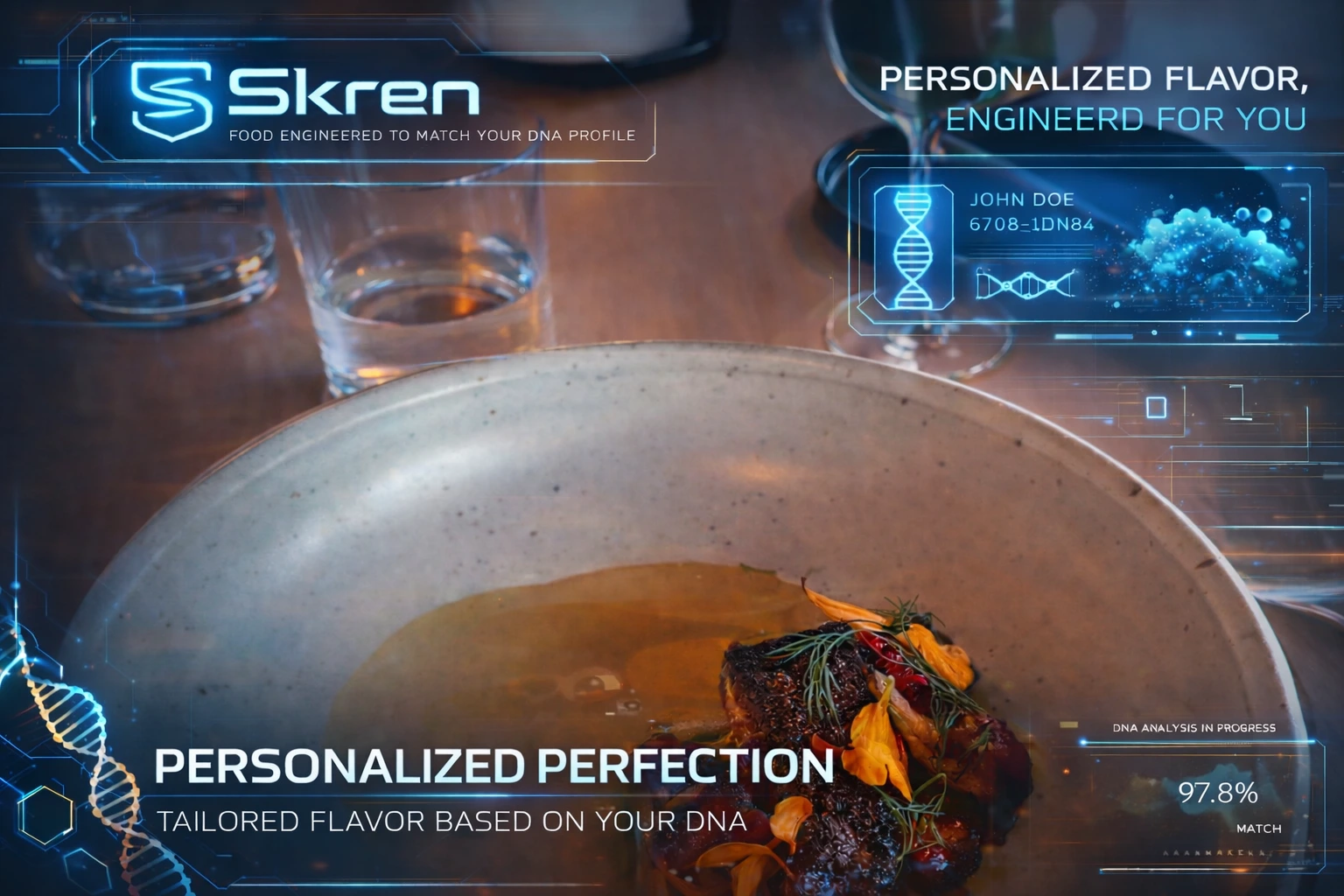
“Genetic personalization,” he said, setting the tablet on my desk. “It’s the future of fine dining. Skren Biosecurity has perfected it.”
Great, I thought. Another tech evangelist.
I looked at the screen. Diagrams of DNA helices. Charts about flavor compounds and receptor optimization.
“I don’t understand,” I said.
Trevor smiled wider. “Your guests submit a DNA sample. Cheek swab, painless, takes ten seconds. We analyze their genetic profile—taste receptors, metabolic markers, nutritional needs. Then with the help of our proprietary A.I. models, you design dishes molecularly optimized for their biology.”
“That sounds like science fiction,” I said.
“It’s science fact,” Trevor said. “Restaurants in Tokyo, Singapore, New York—they’re already doing it. You want to charge what they charge? You need to offer what they offer.”
He showed me images via smart glasses SkrenLink. A sample menu featured prices I’d never imagined: $850 per person for a tasting menu.
“How much does the equipment cost?” I asked.
Trevor waved his hand. “The profiling is outsourced. You send the samples to our Skren labs. We send back the data. You integrate it into your prep. The real value is the database. Once you have a guest’s profile, they’re locked into your ecosystem.”
Something about that word—ecosystem—made my skin crawl.
Trevor seemed to notice. “I should add that this offer is very exclusive, coveted in the industry,” he said. “Only our Head of Special Projects chooses which restaurants qualify. She is highly selective.”
“I’ll think about it,” I said.
Trevor left his card—heavy stock, Skren logo embossed in silver.
That night I told Hannah about it.
She was feeding Gage at the kitchen table. She looked up at me, eyes sharp.
“Don’t,” she said.
“Don’t what?”
“Whatever you’re thinking,” she said. “Don’t.”
“It could save the restaurant,” I said.
Hannah’s voice stayed level. “At the clinic, we’re starting to see genetic screening requests,” she said. “People want to know their risks—cancer markers, heart disease, neurological conditions. It’s expensive. Most insurance won’t cover it unless you’re symptomatic.”
“What does that have to do with—”
“The people asking for it are your customers,” Hannah interrupted. “The people who can’t get it are your staff. You start collecting DNA for fancy dinners while workers can’t afford basic health screening.”
I didn’t answer.
“This technology was supposed to save lives,” Hannah said. “Now it’s for optimizing your scallops.”
I went back to Trevor two weeks later.
The pricing model was simple. I paid per profile processed. In return, I got access to a database that told me exactly how to make each guest’s meal feel transcendent. Not better. Not healthier. Just more aligned with their biology.
The first guest to try it was Walter.
He submitted his sample with the enthusiasm of someone trying a new tech gadget. A week later, I served him a dish designed around his genetic markers: specific umami compounds his receptors responded to, cooking temperatures that matched his heat sensitivity, acidity levels calibrated to his palate.
He closed his eyes after the first bite.
“Bernie,” he said, “this is extraordinary.”
I felt a surge of something I mistook for pride.
Within six months, genetic profiling was mandatory at Wingsong. You couldn’t book a table without submitting a sample. The database grew. The prices rose. The demand exploded.
People loved it. They loved being told the food was designed for them. They loved the exclusivity of it. They loved saying “genetically optimized” at cocktail parties.
They didn’t simply eat the dishes we served; they took them in, like they would an opera.
I told myself it was just better storytelling.
Hannah stopped eating at Wingsong.
One night I asked her why.
“Because I don’t want my DNA in your database,” she said.
“It’s secure,” I said.
She looked at me like I’d said something obscene. “Bernie, I work at a clinic. I know what happens to medical data. It gets shared, sold, hacked. You think your restaurant server is more secure than hospital systems?”
“It’s just for food,” I said.
“It’s never just for food,” she said.
I opened a second restaurant. Then a third. All with genetic profiling. Investors started calling. A Seattle magazine called me “the island’s culinary visionary.”
The council started talking about mandatory genetic health screening for ferry workers. “For safety,” they said. To prove they didn’t have conditions that might cause incidents. Lack of budget made that idea a pipe dream.
Hannah came home from the clinic one night, face pale.
“What happened?” I asked.
She sat down at the table and didn’t look at me. “A woman came in last week,” she said. “Mid-sixties. Teacher. Used to work at the elementary school before it closed.”
I waited.
“She wanted genetic screening,” Hannah continued. “She’s been having symptoms—fatigue, joint pain, cognitive issues. She thinks it might be early-onset something. She wanted to know.”
“Did you test her?”
Hannah’s hands clenched. “She couldn’t afford it,” she said. “Her insurance won’t cover preventive screening. The out-of-pocket cost is two thousand dollars.”
I started to speak but Hannah kept going.
“She asked if there were payment plans. I had to tell her no. She left. Two days ago she collapsed at the ferry terminal. By the time they got her to the hospital, she’d had a stroke.”
My chest felt tight. “Is she—”
“She’s alive,” Hannah said. “But she’ll never be the same.” She finally looked at me. “Her name is Claire. Claire Davidson. She taught kindergarten for thirty years.”
The name didn’t mean anything to me.
“She has a daughter,” Hannah said. “Works in your kitchen. Maddie.”
I felt something cold settle in my stomach.
“Maddie knows,” Hannah said quietly. “She knows we could have caught it. She knows the technology exists. She knows her mother couldn’t afford what your customers pay for without thinking.”
I wanted to say it wasn’t my fault. I wanted to say I didn’t make the healthcare system.
But I had built a restaurant empire that proved the technology worked perfectly—for the right people.
Maddie had started working for me the first summer.
She was quiet, observant, early twenties, hair always tucked under a hat, eyes sharp. She worked the line and kept her station clean. She moved fast without looking frantic. She tasted everything. She asked questions that showed she was thinking, not just following.
She was good. Precise. The kind of cook who understood that cuisine was chemistry and care in equal measure.
Maddie had mentioned once that her mother was forced to retire when the school closed and I’d filed it away with other tragedies I couldn’t fix.
Maddie never mentioned it again.
One night, when the rush slowed, she said, “Why did you change the bread?”
I was wiping down the station. “What?”
“The bread,” she said. “It used to be from that baker on the mainland. Now it’s... different.”
“It’s still good,” I said.
“It’s fine,” she said. “But it’s not special.”
I looked at her. “Do you want special, or do you want your paycheck on time?”
She didn’t flinch. “I want both,” she said.
I almost laughed. Not because it was funny, but because it was so naive.
“You can’t always have both,” I said.
She held my gaze. “You can choose what you care about,” she said.
Later that night, Cory said, “She’s right about the bread.”
“Cory,” I said, “go home.”
He stared at me a second. “You ever think maybe Walter was wrong, and that slick Skren salesman?” he asked.
I didn’t answer. He shrugged and left.
Maddie started helping with bookkeeping when she noticed my invoices didn’t match my inventory. She was good at it. She found errors. She negotiated with vendors. She caught a bartender skimming cash.
I trusted her with more and more. Including access to the genetic database.
“I need someone to manage profiles,” I told her. “Cross-reference dietary restrictions with genetic markers. Make sure the data stays organized.”
Maddie looked at me. “You want me to handle people’s DNA?” she asked.
“You’ll have administrative access,” I said. “It’s secure.”
“Of course,” she said.
Four years later, she was gone.
So was over a hundred thousand dollars.
I found out on a rainy Tuesday when my accountant called and said, “Bernie, we have a problem.”
I knew immediately.
Hannah didn’t look surprised when I told her.
“She stole from me,” I said.
Hannah nodded. “Yes.”
“That’s it?” I snapped. “Yes?”
Hannah’s eyes hardened. “What do you want me to say? You trusted her with people’s genetic data. You trusted her with money. You built something that teaches people to take.”
“She had a choice,” I said.
“So did you,” Hannah said.
A few months later Maddie opened her own place across town. Haphazard.
The food was good. Better than mine. The dining room stayed half empty.
Blakeford didn’t want good. Blakeford wanted expensive.
The invitation came a few months later.
Winter Solstice Celebration. One night only. Five hundred dollars per person. Limited seats. A culinary ritual to honor darkness and return.
The card was thick. The typography was tasteful. There was a line about “communal abundance.”
Hannah set the invitation down on the counter. “You’re going,” she said.
“I’m not,” I said.
“You are,” she said again, quieter. “Because you need to see her.”
We left Gage with Hannah’s sister and took the ferry back together that evening.
Haphazard sat tucked between two shops, its windows glowing. Through the glass we could see the dining room packed tight, faces bright in candlelight.
At the host stand, a young man smiled too wide. “Welcome,” he said. “Winter Solstice Celebration?”
“Yes,” Hannah said.
He checked a list. “Chambers,” he said. His smile tightened. “Right this way.”
We were led to a small table near the back. A band played soft jazz. Evergreen garlands hung from the ceiling. Candles burned low. The air smelled like citrus and pine.
Walter was two tables over. He looked surprised to see me, then lifted his glass in greeting.
A server approached with menus. “Good evening,” she said. “Thank you for joining us. Tonight is about honoring the dark and welcoming the return. Chef Maddie will be speaking later. We’ll need to collect your genetic profiles if you haven’t dined with us before.”
She held out a kit with cheek swabs.
Hannah’s hand found mine under the table.
I took the swab and ran it along my cheek. Hannah did the same. We sealed them in the tubes and handed them back.
“Thank you,” the server said. “These will enhance your experience.”
The first course arrived twenty minutes later. Oysters dressed with something bright and sharp, a citrus granita that snapped on the tongue, then melted into brine. It was simple and precise.
Hannah watched my face.
“It’s good,” she said quietly.
I didn’t answer.
The second course was mushroom broth poured table-side. The aroma rose and filled my head. It tasted like forest floor and patience.
Walter leaned over from his table. “Bernie,” he called softly, “isn’t this something?”
I looked at him. “It’s food,” I said.
The third course was fish. Perfectly cooked. A vegetable element that tasted fresh despite winter.
The fourth course was meat. Slow-cooked, tender, with a crust that crackled.
But somewhere around the third course, I started to feel off.
Not sick exactly. Just wrong. My heart was beating faster. A faint nausea rolled through my stomach. My hands felt cold.
I looked at Hannah. She was pale, touching her throat.
“Do you feel—” I started.
She nodded.
Around the room, other people were shifting in their seats. Someone coughed. Walter’s wife put down her fork and pressed her hand to her chest.
Then, between courses, Maddie appeared.
She stepped into the center of the room and lifted a microphone. The band gathered up their things and made their way out the back exit. Conversations died quickly.
Maddie wore a simple black dress. Her hair was pulled back tight. Her face looked calmer than I expected.
“Good evening,” she said. Her voice carried with amplified gravity. “Thank you for coming to Haphazard.”
Polite applause.
“This night is about the solstice,” she continued. “It’s about darkness. It’s about what we do when the light feels far away. It’s about community.”
People nodded.
Maddie’s eyes moved through the room, then landed on me.
“I want to thank you for trusting me,” she said.
Some people laughed, thinking it was charming.
“I learned a lot,” Maddie said. “I learned how to run a kitchen. I learned how to manage genetic profiles. I learned what people will pay for, and why.”
Walter smiled.
Maddie’s mouth tightened. “Tonight,” she said, “we’re doing something different.”
A few people chuckled.
Maddie lifted her hand. Two staff members moved quietly to the front doors. Another moved to the back.
I felt Hannah’s fingers touch my wrist.
The staff at the doors turned locks.
The sound carried. A clean metallic click.
A door at the side opened.
They came in wearing masks.
Not cute masks. Crude shapes, pale and rough, with long noses and hollow eyes. Their clothes were dark. Each carried a rifle.
The room froze.
Then the screaming began.
One of the masked figures lifted a rifle and fired into the ceiling.
The crack tore the room open. Plaster dust drifted down.
Silence slammed back into place.
Maddie lifted the microphone again. “Sit down,” she said.
People obeyed.
A masked figure moved along the wall and said, “Phones. Now.”
Another carried a bin. They began moving table to table, demanding phones, jewelry, wallets.
My chest felt tight. My breathing was shallow. Around the room, people were showing symptoms—sweating, shaking, gasping.
The bin reached our table.
“Phones,” a masked voice demanded.
Hannah’s hands were shaking. She placed her phone in the bin. I did the same.
My heart was pounding harder now. Not just fear. Something else. Something chemical.
Maddie turned to face us. “You’re wondering what you’re feeling,” she said.
Walter stood up. “What are you doing?” he demanded.
Maddie looked at him. “I’m honoring darkness,” she said. “I used your genetic profiles. All of them. Every vulnerability, every marker, every receptor sensitivity. I designed tonight’s meal specifically for each of you.”
A woman at the front began to cry.
“Your oysters contained compounds calibrated to your blood pressure markers,” Maddie said. “Your broth included ingredients that interact with your metabolic profiles. Your fish had allergens selected for your immune responses.”
Someone whispered, “Oh my god.”
“Nothing illegal,” Maddie continued. “Nothing immediately lethal. Just carefully designed to make you feel what my mother felt every day. Stress. Discomfort. The knowledge that your body is betraying you and you can’t afford to fix it.”
Hannah’s hand tightened on mine.
Maddie’s voice rose. “My mother taught kindergarten here for thirty years. She had symptoms. She knew something was wrong. She wanted genetic screening. She couldn’t afford it. She had a stroke because the technology that could have saved her was being used to make your lingcod taste better.”
Walter’s wife sobbed, “This is insane.”
“This is genetic personalization,” Maddie said. “You wanted food designed for your DNA? This is food designed for your DNA.”
Maddie lowered the microphone. “Good,” she said. “Now we’re going to leave.”
A man near the window said, “You can’t just—”
A masked figure snapped, “Stand up.”
Chairs scraped. People rose, disoriented. Someone tried to move toward the front and was shoved back.
“Single file,” Maddie said. “Out the back.”
The back door opened. Cold air rushed in. The smell of the Sound, wet and sharp, filled the room.
We were marched out into an alley where rain fell. A yellow school bus waited, engine running, lights off.
“What the hell,” Walter said, voice high now. “Do you know who I am?”
A masked figure prodded him forward. “Get on,” they said.
We climbed onto the bus.
The seats smelled like old vinyl and damp. It was warm inside. People were crying. Someone was praying.
A masked figure moved down the aisle and barked, “Heads down.”
Another figure handed out black sacks.
Hannah stared at one, horrified. “No,” she whispered.
I leaned close. “Do it,” I said.
She pulled the sack over her head with trembling hands.
I put mine on.
The world went dark.
The bus lurched forward.
My heart was hammering now. Not just fear—the compounds were working. I could feel my pulse in my throat, irregular. My hands were numb. Sweat ran down my ribs despite the cold.
After what felt like too long, the bus stopped.
“Out,” a voice commanded.
Hands grabbed shoulders. We were guided down the steps. Mud squelched under my shoes. Rain hit my coat.
Someone ripped my sack off.
Light stabbed. I blinked hard.
We were at a dock. Not the public ferry dock. A private one, older, with splintering wood. The water below was black.
A boat waited.
A masked figure pointed. “On,” they said.
We were herded onto the boat.
Maddie stepped on last. She was not wearing a mask. Rain dotted her hair.
“Everyone,” she said loudly over the engine noise, “listen.”
The boat pulled away from the dock. The island lights receded. The choppy seawater reflected them back like a shattered mirror.
I looked at Hannah. Her cheeks were wet with rain and tears. Her breathing was rapid, panicked.
Around me, people were getting worse. Walter clutched his chest. His wife was hyperventilating. A man collapsed to his knees.
Maddie stood near the bow, gripping a railing.
“You took this island,” she said. “You took it and you called it a lifestyle.”
Walter shouted, “You don’t know what you’re talking about!”
Maddie snapped her head toward him. “I know exactly what I’m talking about,” she said. “My mother taught your children. She taught the children of the people who used to live here before you priced them out. When she needed help, she got nothing. When the school closed, she had to retire early. Years later she had a stroke because she couldn’t afford a genetic screening that costs less than one of your dinners.”
A woman called, “That’s not our fault!”
Maddie laughed once, short. “Whose fault is it?” she asked.
The boat cut through waves. Water sprayed up, cold on my face.
“You come to restaurants and you talk about community while you vote against housing,” Maddie said. “You use technology that was supposed to save lives so you can feel special. You turn genetic medicine into luxury cuisine.”
Her gaze swept the crowd and landed on me.
“And you,” she said, pointing. “Bernie.”
Walter turned and stared at me.
Maddie stepped closer. “Bernie built an empire on genetic profiling,” she said. “He collected your DNA. He stored it. He used it to charge you more. He helped normalize the idea that your biology is worth trading for a perfect meal.”
I felt Hannah stiffen beside me.
“The database Bernie built?” Maddie continued. “I copied it. All of it. Every profile. Every marker. Every vulnerability. That’s how I knew exactly what compounds to use tonight.”
Someone screamed.
“And now you’re going into the water,” Maddie said. “Now you feel what it’s like to be cold and powerless. Now you pay with your bodies.”
A woman screamed. A masked figure snapped a rifle up.
Hannah grabbed my arm. “Bernie,” she whispered, “we have to do something.”
I scanned the masked figures. Eight, maybe ten. Not all of them held rifles like they meant it.
I saw one near the stern whose hands were shaking.
The boat slowed.
Ahead was darkness. No lights. Just water and wind and the sound of rain.
A masked figure shouted, “Line them up.”
They began pushing people toward the side rail.
“No,” Walter said, voice cracking.
Walter’s wife sobbed. “Please, Maddie, please.”
Maddie’s face was hard. “You’ll see how all this will end,” she said. “Eventually.”
Walter turned suddenly, lunging toward Maddie.
A masked figure swung the rifle stock and hit Walter in the side of the head. Walter collapsed, blood already visible at his temple.
Walter’s wife screamed.
The scream changed everything.
The masked figure who had hit Walter stood frozen, as if shocked by their own action.
I moved toward the shaking masked figure at the stern. Fighting dizziness and cloudy vision, I grabbed the rifle barrel with both hands and yanked hard.
The figure resisted, but weakly. The rifle slipped.
Hannah was behind me. She grabbed the rifle stock and pulled.
The masked figure lost grip.
I had the rifle.
“Gun!” someone shouted.
People screamed and surged. A man grabbed a chair. Someone tackled a masked figure.
The boat rocked hard.
A masked figure raised their weapon toward me.
I didn’t think. I fired.
The shot tore into the night. The recoil slammed my shoulder. The bullet went wide.
But the sound changed everything.
The masked figures flinched. People surged harder.
The boat rocked again.
Maddie moved toward the rail, shouting orders. “Hold them!”
But the guests were no longer guests. They grabbed whatever they could.
A masked figure fired into the air.
The crack was too close. People ducked. A woman slipped and hit the deck.
“Enough!” Hannah screamed.
Maddie turned toward Hannah. “You don’t get to say enough,” she shouted.
Hannah’s voice dropped, suddenly calm. “Maddie,” she said, loud enough to cut through. “If you do this, you will become exactly what you hate.”
Maddie laughed, bitter. “You think I care?”
“I think you do,” Hannah said. “I think you care so much it’s eating you alive.”
For a fraction of a second, Maddie hesitated.
Then, far across the water, something buzzed overhead. Drones. Next a light swept the darkness.
A beam, wide and harsh, moving.
A siren followed.
Coast Guard.
“They’re here!” someone screamed.
The masked figures panicked. A few threw down their rifles and raised their hands.
Maddie, still struggling against a guest who’d grabbed her, looked toward the approaching light.
Something in her face broke.
“It always works out for you,” she said to me, voice low. “It always works out for people like you.”
Two government drones circled above us. The Coast Guard boat drew closer.
“This is the United States Coast Guard,” a voice boomed. “Put down your weapons. Raise your hands.”
I lowered the rifle slowly and raised my hands.
Hannah raised hers too.
Maddie stood still, rain on her face, her hands empty.
The Coast Guard boarded. They moved fast. They disarmed anyone holding weapons. They zip-tied wrists. They guided people away from the rail.
A Coast Guard officer approached me. “Sir,” he said, “are you injured?”
“No,” I said, voice hoarse. “But people are sick. Something in the food.”
The officer’s radio crackled. He spoke quickly into it, then looked at me. “Medical is en route,” he said.
Walter was bleeding but upright now, supported by his wife. A woman held her head and cried. The masked figures were lined up, masks removed. Their faces were younger than I expected. Several had tattoos that read “ALA” in punk rock script. I later learned that ALA stood for the Analog Liberation Alliance.
One of the figures, a man with deep-set eyes, stared at me with pure hatred.
Maddie was led away last.
As she passed me, she spoke softly.
“You’ll be fine,” she said. “You always are.”
The hospital was chaos.
We arrived by Coast Guard boat, rushed to the mainland facility. The emergency room was already prepped—they’d called ahead with descriptions of the symptoms.
A doctor in scrubs approached me and Hannah. “Mr. Chambers? Mrs. Chambers?”
“Yes,” I said.
“We need to run some tests,” he said. “Can you tell me what you ate tonight?”
I described the courses as best I could remember. The doctor typed notes into a tablet.
“Do you have genetic profiles on file?” he asked.
Hannah and I looked at each other.
“The restaurant had them,” I said. “Maddie—the chef—she used our DNA to—”
The doctor held up a hand. “We know,” he said. “The Coast Guard briefed us. We’ve contacted the profiling lab. They’re sending over the database records for all the guests.”
He said it so casually. Like it was routine.
“How long until we’re okay?” Hannah asked, her voice thin.
“We’ll have antidotes ready within a few hours,” the doctor said. “We can synthesize countermeasures once we have your profiles and know exactly what compounds were used. You’ll be fine.”
He left to check on other patients.
Hannah sat in a chair and put her head in her hands.
“A few hours,” she whispered. “They can fix it in a few hours.”
I sat beside her. My heart was still racing, but whether from the compounds or from everything else, I couldn’t tell.
Down the hall, I could see Walter in a bed, already on an IV, talking to his smart glasses. A woman was being examined, vitals taken. Everyone was being helped. Quickly. Efficiently.
“Hannah,” I said quietly.
She looked at me.
“That mom,” I started. “Maddie’s mom. The screening she needed. How much did you say it cost?”
Hannah’s eyes filled. “Two thousand dollars,” she said.
I looked at the emergency room. The staff. The equipment. The genetic lab techs rushing in with data. The doctors synthesizing personalized antidotes.
“How much will this cost?” I asked. “Tonight. All of this.”
Hannah’s voice was flat. “Per person? Probably twenty, thirty thousand. Emergency genetic intervention. Custom pharmaceutical synthesis. ICU monitoring.”
I felt something heavy settle in my chest.
“Insurance will cover it,” Hannah added. “For them.”
We sat in silence.
Three hours later, a nurse gave me an injection. “This should counteract the compounds,” she said. “You’ll feel better in about twenty minutes.”
She was right. Within half an hour, my heart rate normalized. The nausea faded. My hands stopped shaking.
I was fine.
Walter was fine.
Everyone was fine.
The system had worked perfectly.
The next day, Blakeford woke up to a story it could not control.
Helicopters and surveillance drones over the harbor. News vans at the ferry terminal. People in clusters, whispering.
The island’s online groups exploded with posts about safety and crime and how this was proof that outsiders were dangerous.
Outsiders. The word made me dizzy.
The city council called an emergency meeting to discuss “security measures.” There was talk of more police funding, of “tightening ferry access,” of protecting the island.
No one talked about housing, healthcare, or access to genetic screening for workers.
Walter came to Wingsong two weeks later with a bandage on his temple. He sat at the bar like nothing had happened, ordering the reserve wine.
“You know,” he said, “we survived something together.”
I looked at him. “We survived because someone stopped it,” I said.
Walter waved his hand. “Details,” he said. “The point is, the island endured.”
Hannah didn’t come into Wingsong much after the solstice.
One night at home, after Gage was asleep, she sat at the kitchen table and stared at her hands.
“Do you feel anything?” she asked me.
I sat across from her. “What do you mean?”
“After all of it,” she said. “After almost dying. After seeing what the island does to people. Do you feel anything different?”
I opened my mouth, then closed it.
Hannah nodded slowly. “You don’t,” she said.
“That’s not true,” I said. “I’m shaken.”
Hannah’s eyes lifted. “Are you?” she asked. “Or are you just tired?”
I wanted to tell her how I felt about the rifle in my hands. About Maddie’s face. About the hospital.
But what I felt most, when I was honest, was relief that the machine had not broken under me.
“I need to keep going,” I said.
Hannah’s voice went flat. “Of course you do,” she said.
Maddie took a plea deal. The papers called it a “radical kidnapping plot.” They interviewed island residents who talked about how grateful they were for law enforcement.
A columnist in Seattle wrote a piece about class resentment and genetic inequality. People on Blakeford called it slander.
I never pursued the money she stole. The time and stress I’d have to spend picking at that old wound didn’t seem worth it.
Cory quit that week.
He came into the kitchen after service and said, “I’m done.”
“Because of what happened?” I asked.
Cory shook his head. “Because of what didn’t happen,” he said. “People almost got killed and you raised prices again. You called it security fees.”
“It’s a business,” I said.
Cory looked at me a long time. “You used to be a cook,” he said. “Now you’re a gatekeeper.”
He took off his apron and left it on the counter. “Good luck,” he said, and walked out.
I hired a new sous-chef from Seattle within a week.
That winter, the ferry horn still sounded at nine forty.
The island still lit up for the holidays.
Wingsong stayed full.
People came in and told stories about the solstice night as if it was a thrilling detour in their otherwise comfortable lives.
“We were so brave,” a woman said at table eight.
“It was terrifying,” her friend replied, then smiled. “But what an experience.”
I wanted to tell them to stop talking.
Instead I sent out the next course.
A few months later, my marketing consultant pitched a campaign.
“We can’t ignore what happened,” she said. “We should own it. Position Wingsong as the island’s sanctuary. Safe, curated, protected. Enhanced genetic security protocols.”
Hannah wasn’t in the room. She didn’t come to these meetings anymore.
I stared at the slide that said WINGSONG: WHERE YOUR DNA IS SAFE.
“Okay,” I said. “Let’s do it.”
That night, at home, Hannah noticed the printout.
She pulled it out and read it silently.
Then she set it down carefully.
“You’re using it,” she said.
“It’s business,” I replied automatically.
Hannah shook her head. “You’re using their fear,” she said. “You’re using Maddie’s collapse. You’re using the fact that people were desperate enough to weaponize genetic technology.”
“I didn’t make them do that,” I said.
“No,” Hannah said. “You just made the island where it makes sense.”
I felt anger rise. “So what do you want from me?” I demanded. “To shut down? To sell? To leave?”
Hannah’s eyes shone. “I wanted you to stay you,” she said.
She stood up. “I’m going to bed,” she said.
In the dark later, I lay awake and listened to the house settle. I checked my Webb homeLink monitoring system. Gage breathed steadily in his room; his biometrics displayed as normal. Hannah lay beside me, turned away.
I thought about Maddie in prison. Her meals wouldn’t be genetically tailored to match her palate.
I thought about her mother collapsing on the floor at the ferry terminal.
I thought about the hospital, the doctors, the antidotes synthesized in three hours.
I thought about the two thousand dollars that would have prevented Claire Davidson’s stroke.
In the morning, I got up early and went to Wingsong.
The dining room was empty. I walked through the kitchen alone, checking stations, touching surfaces. I saw my face reflected in kitchenware.
The commHub pinged with a reservation alert.
I turned to the hovering screen. A party of ten had booked the new “Sanctuary Tasting” with enhanced genetic security protocols.
I accepted the booking.
Outside, Puget Sound was gray. The ferry moved in the distance. The horn sounded, and it did not feel lonely.
It felt ordinary.
And the island kept breathing, slow and satisfied, as if nothing had ever tried to drag it into the water.